
San Francisco, August 30, 2011
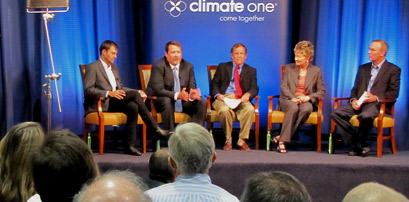
Climate One at the Commonwealth Club held a panel discussion Monday on the Keystone XL pipeline, “Canadas Oil Sands: Energy Security or Energy Disaster?”.
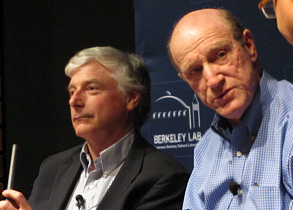
Panelists (left to right): Jason Mark, Earth Island Institute.
Alex Pourbaix, President of Energy and Oil Pipelines, TransCanada
Carl Pope, Chairman of the Sierra Club, Cassie Doyle, Consul General, Canada
Representing TransCanada in favor of the pipeline, Alex Pourbaix argued that the United States will continue to rely upon imported gas for decades to come, and that Canada gas offers the U.S. increased energy security from a friendly source with similar values. Cassie Doyle, Canada’s Consul General also highlighted the Canada/US friendship theme, mentioning that Canada and the U.S. have similar environmental standards and the same greenhouse gas emission reduction targets. “Canada has adopted a GHS reduction target that’s exactly the same as the U.S”. Ironically, these common targets exist because Canada weakened its targets from its earlier Kyoto commitment and now matches the weaker U.S. targets offered in Copenhagen of 17% below of 2005 levels by 2020, which are said to be equivalent to a mere 3 to 4% below of 1990 levels.
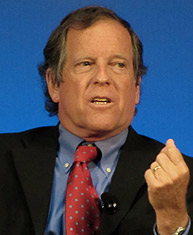 |
| “If we burn all the conventional crude that there is in the world, we would fry the planet. If we burn all the conventional crude plus a lot of unconventional crude, we doubly fry the planet. We really can’t afford to become dependent on this much oil.” ~ Carl Pope |
Carl Pope, Chairman of the Sierra Club, said that in addition to being dirty, the tar sands oil won’t even deliver on the promise of increasing the U.S. fuel supply, since most of the oil will ultimately be exported from the U.S. after being refined in Texas, so that the United States essentially assumes environmental risks and costs without benefit. Further, the construction of the pipeline extends a dangerous U.S. oil addiction rather than moving toward renewable energy.
Jason Mark of the Earth Island Institute, explained that tar sands oil has a higher carbon footprint than other types of oil in part because the extraction processes requires pumping steam into the ground, an energy intensive, greenhouse gas emitting process. He framed the issue as an important policy choice as to whether or not the United States will move away from fossil fuels. He suggested that U.S. fuel consumption may in fact drop as tighter fuel efficiency standards come into effect. Whereas Cassie Doyle highlighted the billions of dollars of contracts going to aboriginal companies in the tar sands region, Jason described communities in the region as being torn apart and mentioned lawsuits by the Beaver Lake Cree against the government for violations of treaty rights,
” If you’re a First Nation People, if you’re a Beaver Lake Cree and you’re seeing your homeland being destroyed and you’re being told, well you can either work in our mines, you can take a government handout, or you can starve. That’s just not very fair.”
When the mic was opened up for audience questions, Rose Braz of the Center for Biological Diversity, stepped up and put the panel’s discussion into the context of the events unfolding in the nation’s capital, where there has been ongoing civil disobedience with hundreds of arrests in protest of the pipeline.
“As of today more than 600 people have been arrested in front of the White House … climate scientists, farmers, climate activists, communities of faith. People from all across the country, all ages …putting that line in the sand, saying no more expansion of this oil infrastructure, and really calling on President Obama who has this within his power. You know this is not a Congressional discussion, this is not something that has to happen in international negotiations. We are saying this is a line in the sand, this is a long overdue moment when we need to say no more to our carbon addiction. … the people really are standing and being arrested as we speak right now”
Those arrested, which now number over 1200, include well known actors, activists such as Bill McKibben & Naomi Klein, and indigenous leaders including Debra White Plume, granddaughter of Chief Red Cloud, and Tom Goldtooth.
“We need to say, the fossil fuel era was the twentieth century, it’s over, and we’re going to invest in the future. And we cannot afford for tar sands oil to be the future” ~Carl Pope
Selected Excerpts from the Panel Discussion:

Alex Pourbaix:
00:00 “Most of the forecasts that are out there, including the forecast from your federal government, would expect that that oil demand in the U.S. will likely remain stable for many years to come. So were at the point where it is very apparent that U.S. is going to need to continue to import oil for a number of decades and really were now down to the question of where you want that oil to come from.”
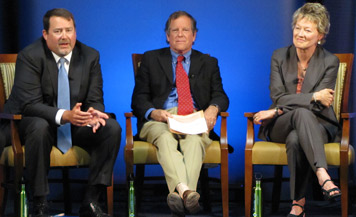 |
| “The oil sands really represent the engine of economic growth for Canada for at least the next five decades. If the U.S. market were to be closed off … they’ll continue to develop and produce that crude.” ~ Alex Pourbaix |
“Canada’s already the largest importer of oil to the US. And we would expect … with growth of production with the oil sands, we have the ability to add significantly more imports to the U.S. So it’s a question of energy security. If you take a look at the other countries that import oil to the U.S., they are largely countries that in many cases do not share the values of Americans, and in certain cases are actively against a lot of those values, and to suggest that those other countries are more responsible environmental citizens than Canada, really begs comprehension to me. Canada has proven itself to be a very good steward of the environment. We have excellent transparent environmental rules for the development of our resources. And I think of when you get down the point of where do you want to get your oil from, it is far more compelling to be getting your oil needs from Canada rather than getting it from other countries such as Libya, Nigeria, or Venezuela.”
Carl Pope:
1:37 “So what’s going to happen with this oil, is it will be shipped to refineries in Texas and will be refined into diesel, some gasoline, some jet fuel, and a large part, perhaps all, of that diesel, jet fuel, and gasoline will be exported to Europe and Latin America. The United States will bear the environmental risk, the United States will face higher oil prices, in fact the state department estimates that building this pipeline will increase – in the official EIS which Alex is otherwise going to defend – the official EIS says that America’s export bill will go up 1.5%, 6 billion dollars a year, if we build this pipeline in any of its options.”
“So this is really not what it’s being presented as. This is not a way to give America more access to affordable secure tar sands oil, albeit dirty. That’s the story you hear, yes it’s dirty but you get these other benefits. We’re not going to get these other benefits. The oil companies are going to make larger profits, that’s who’s going to benefit – cause the oil is not going to stay in the United States to bring our prices down. They are very clear about the fact that they think prices in the Midwest for oil are too low. They don’t like the fact that we’re not right now paying OPEC prices for oil in the Midwest. We are on the coasts, because on the coasts, the oil that comes here is – OPEC can manipulate the price. OPEC is not able to manipulate the price in the American Midwest and that’s what they’re trying to change.”
Q “How does Alberta oil compare to other crude oil in terms of its carbon content…?”
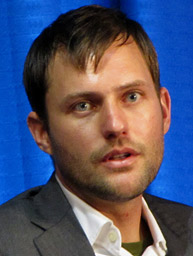 |
| “The question is really, is the United States going to be complicit in burning megatons more of carbon dioxide that is going to fuel runaway climate change” |
Jason Mark:
3:26 “It’s got a bigger carbon footprint. If you just take even some of the most conservative figures which come from Cambridge research associates, they say to get a barrel of oil from the Canadian Tar Sands to the retail pump is thirty to seventy percent more green house gas intensive than the average barrel of oil consumed in the United States. Now if you actually go what’s called wells to wheels, the whole life cycle, it’s still five to fifteen percent more carbon intensive. Now maybe five to fifteen percent doesn’t sound like a huge number, but at this point in time, I don’t think we can afford any increase in greenhouse gas emissions or greenhouse gas intensity. … and especially some of the new processes that are coming on line, which is called in situ extraction where they inject steam into the ground. That takes a lot of energy to do that. Canada is using one fifth of all of its natural gas just to extract tar sands oil. You have to use a lot of energy to create some energy. And so the greenhouse gas intensity is much higher than the average barrel of oil, and I think that to me that is one of the most compelling claims. I was really surprised, you know the U.S. State Department said that this pipeline will have no significant environmental impact. As a journalist I felt that was the classic example of the headline writer not actually reading the story. Because when you go into that report, you see that the state department itself says that … according to US Department of Energy numbers, oil from the tar sands are 17% more greenhouse gas intensive. That’s a significant environmental impact, to spill all of this oil into the atmosphere, and I don’t think we can afford it.”
Alex Pourbaix argued that the GHG emissions of oil sands crude was unfairly being compared with WTI, a light sweet crude, rather than the more commonly used, and more carbon intensive, heavy crude:
8:22 “The problem is, is that WTI in no way shape or form represents the average barrel of oil that is consumed by refineries in the U.S. The refineries in the US are increasingly using heavy oil in their refinery runs. That makes sense, heavy oil is a lot cheaper than light sweet oil. And light sweet oils supplies worldwide are decreasing because it was the highest quality it was the easiest to find. We’re seeing the slate of oil production across the globe moving increasingly to heavy. So when you think about what happens if no more Canadian oil is allowed to get to refineries in the U.S. gulf cost. Those refineries spent tens of billions of dollars to configure themselves so that they can run these heavier crudes. These heavier crudes are cheaper. If Canadian oil does not get to them, they will source heavy crudes elsewhere in the globe and you will get the same emissions being produced worldwide.”
“There is a big difference between assuming that by stopping Keystone XL you’re going to stop the development of the oil sands. The oil sands really represent the engine of economic growth for Canada for at least the next five decades. If the U.S. market were to be closed off for incremental barrels of Canadian oil, it is not a fair assumption to assume that the people in the oil sands will stop developing that crude. They’ll continue to develop and produce that crude. They’ll do it reliably and they will do it conscientiously. But it will go to other markets, but the globe and the atmosphere does not respect borders.”
Carl Pope:
10:18 “So the reality is that the world cannot long term – there’s enough conventional crude – if we burn all the conventional crude that there is in the world, we would fry the planet. If we burn all the conventional crude plus a lot of unconventional crude, we doubly fry the planet. We really can’t afford to become dependent on this much oil. You’re right, the issue is demand. But it is not necessarily the case that the only way to change course is just to go after demand. We’re going after demand, Canada is going after demand. I think that this is a bad project from a bad industry from a fundamentally good country, I want to be clear I don’t want to trash Canada. We’re not so great. But what we discovered was once you build these facilities, once you build this infrastructure for an oil dependent economy, it’s much more expensive to move off of an oil dependent economy.”
“Tar sands oil basically doesn’t really make economic sense unless the price of oil is north of $80 a barrel. The world cannot afford to continue to produce huge volumes and consume huge volumes of $80 a barrel oil. That will make Alberta rich, it’ll make Saudi Arabia rich, it’ll make North Dakota rich, it’ll make Alaska risk, it’ll make Venezuela and Kuwait rich, but it will impoverish the rest of the world. We need to be putting the dollars that are currently going in to developing the tar sands into – Canada needs to be developing an economy that is not dependent for the next five decades on the growth of the tar sands industry, because if the tar sands industry grows for the next five years, Canada’s permafrost will all melt.”
“We cannot afford in the United States to have Canada give us another fix – and this is another fix – for our addiction to oil. And we cannot afford to become the transit pipeline for continuing to feed oil to Europe and Latin America. The world needs to get off oil.”
Jason Mark
12:25 “I just simply don’t understand this argument that, well if we don’t take it [tar sands oil], someone else is going to take it, so we therefore should just take it? I mean, that’s not the question on the table. The question is really, is the United States going to be complicit in burning megatons more of carbon dioxide that is going to fuel runaway climate change. I mean if the Chinese want to jump off the atmospheric version of the Golden Gate bridge, that doesn’t mean that we have to jump off to the bridge as well. I mean , I just don’t get it. The choice here facing Americans, Alex, is fundamentally , do we want to be consuming more oil? And I agree with you, I don’t want to get lost in the weeds on a conversation about the fractions of a percent. The question really is, as Carl said, do we continue to make investments that leave us on the path of a carbon intensive economy, or when do we start to make the decisions – when do we make the hard decisions that say we’re going to stop using oil, or we’re going to decrease our dependence on oil. And this is one of those litmus tests. This is one of those places where we draw a line in the sand, we say we have to start someplace. And the place to start is by saying no to the Keystone XL pipeline. Because, otherwise we just keep postponing the future. Oh we’ll eventually get around to decreasing our dependence on oil. This is a place where we say, nope, we’re going to take a u turn and start pursing a clean energy economy.”
Alex Pourbaix:
13:40 “You know the U.S. is going to consume oil at some level which will probably require imports for a very very long time. The U.S. can choose to deprive themselves of this source of oil, but the oil is going to be developed as I said before, and I think there are a lot of easier targets if people really want to make a meaningful impact on reducing greenhouse gas consumption in the U.S.”
Carl Pope:
14:10 “Our coal footprint is enormous, it is criminal, it is toxic, it is coming down. But it is very interesting when we debate the coal issue with Peabody coal they make exactly the same argument that you make. They say if you don’t use our coal here in the United States, those people over in China or India are going to burn it.”
“That’s the argument they use to rebut our effort to get American investment dollars and American focus on clean energy substitutes. Keystone XL is making exactly the same argument. If you don’t take it, it’ll go somewhere else. If we don’t give it to you, you’ll take it from somewhere else. The argument we’re making is 1) We don’t need it, 2) We can get off oil. 3) There are actually lots of things that are cheaper as a way of transporting than oil at $8 a barrel. $8 a barrel is not a bargain, and that’s what tar sands oil has to cost at volume.”
“We need to move this country – and I would hope that Canada would move itself but I’m not Canadian so that’s ultimately up to you – we need to say, the fossil fuel era was the twentieth century, it’s over, and we’re going to invest in the future. And we cannot afford for tar sands oil to be the future.”
Carl Pope:
@26:04 “We have already reached the earliest of the tipping points. The weather that you experience for the rest of your life will have been influenced by the increase of greenhouse pollutants in the atmosphere. There are more severe tipping points coming. We don’t know precisely what the level of damage is at a specific atmospheric concentration of carbon and methane. But we know that we certainly cannot have confidence that we are not getting close to what most people would consider catastrophic tipping points. And it is clear that the longer we continue to believe, that “oh we’re running out of sweet crude, but there’s all this heavy stuff, gunk in the ground, and we’ll just use that. That’s not sending us the right message. One of the important things about stopping the coal fired power plants that were going to be built in the United States was, it sent America’s public utilities a message, get serious about renewables. If we stop the Keystone XL pipeline, it will send America’s public industries a message, get serious about getting off of oil.”
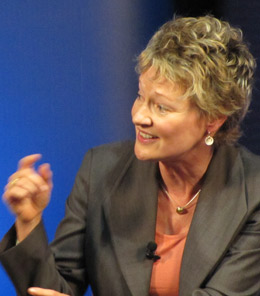 |
| “The economic benefits for both Canada and the United States of the oil sands development can’t be underestimated. It is a major economic driver.” |
Cassie Doyle
15:56 “The communities around the oil sands have received significant economic benefits from its development, in employment, in funding going into companies. For instance, Aboriginal companies in the oil sands have received billions of dollars of contracts, have gone into those communities around the oil sands. So, I mean like any kind of boom, this is a major energy play, the largest in North America, you’re going to get concerns around kind of an overheating of the economy. But the economic benefits for both Canada and the United States of the oil sands development can’t be underestimated. It is a major economic driver.”
Jason Mark
16:35 “Many First Nations feel that the tar sands development is systematically shredding the rights that they’ve been guaranteed under treaties with the Canadian government. And so, you know there’s some commentators in Canada that like to set up this dichotomy between supposedly ethical oil from Canada and conflict oil from other countries. And in fact there’s no such thing as fair trade gasoline. Conflict and strife follow oil you know like white on rice, I don’t know, it’s just part of the package, and you see that conflict in the First Nation’s communities, that are really torn apart, where yes some people have these companies that are doing very well… and at the same time, many people there feel and see that their traditional cultures and the ecosystems on which they have always depending are really being destroyed. You’ve got at least one First Nation, the Beaver Lake Cree, who have filed a lawsuit against both the Canadian Federal Government and the Government of Alberta, saying that their treaty rights have been violated by the tar sands development there. Now that’s going to slog its way through the Canadian courts for quite a while, but if the Canadian Supreme Court were to find that in fact this development has violated their First Nation Rights, it’s going to be very hard to say that this is ethical oil or that this is somehow better than other places. I agree with Carl that yes, the First Nations Aboriginal people of Canada have more rights, than say the Ogoni people of the Niger Delta, or than say, women in Saudi Arabia.”
“But I don’t know that that’s really much of a consolation. If you’re a First Nation People, if you’re a Beaver Lake Cree and you’re seeing your homeland being destroyed and you’re being told, well you can either work in our mines, you can take a government handout, or you can starve. That’s just not very fair.”
Alex Pourbaix:
21:11 “We are comfortable with our state of the art pipeline that we’re going to be very safe in that area”
Carl Pope:
21:20 “I’m sure that BP was comfortable they could produce Macondo safely. I’m sure that Tokyo Electric was confident that their power plants would survive the earthquake and the tsunami. The fact is, there are some situations in which, yes you may have a very long track record of something catastrophic not happening, but when something catastrophic happens, you can’t undo it. And the question is, which is being raised particularly in the state of Nebraska, particularly in the context of the routing of this pipeline through a particularly sandy, an area of the state which is viewed by people of the state as being particularly at risk, why shouldn’t we adopt yet another layer of safety, and reconfigure the routing of this pipeline. Because whatever reassurances and confidence TransCanada may have, they have had pipeline spills, every pipeline operator has had pipeline spills, most of which don’t end up being catastrophic, but one of these days one of them will. The bigger the pipeline and the more vital the water source, the higher the risk of a catastrophic spill”
Cassie Doyle
23:40 “Can I just say that I think that whether or not the Keystone pipeline is built that will not have any impact on the amount of carbon that the United States as a country uses. So I think that there has been an unfair targeting, because as we mentioned there are still tankers coming in, you know, bringing millions and millions of barrels of oil into the United States via tanker which are a much less safe.”
Report by James George

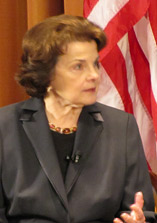 California Senator Dianne Feinstein appeared at the Intercontinental Mark Hopkins Hotel in San Francisco on Wednesday and was interviewed by Greg Dalton of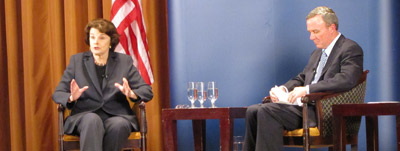
 “However what we have is a lack of attention to the whole fuel cycle, and particularly the spent fuel cycle. Hot rods are put in pools where they remain for up to 24 years now in our state. They should remain there for five to seven years. Then they can be transferred to what are called dry casks, which are like cylinders that are made to survive – they were made as transfer products for the fuel rods to be put in and transferred into permanent nuclear storage somewhere. That was going to be Yucca Mountain. Yucca Mountain is no more. I believe very strongly that we need either regional or centralized nuclear fuel storage. I think it’s asking for trouble to keep hot rods in spent pools for decades and dry casks right on the site of nuclear reactors. I think they should be moved away.”
 The fuel rods also melted as the accident progressed, and thus Budnitz describes the accident as ‘a meltdown’, with an estimated one third to two thirds of the fuel rods in the three active reactor cores having melted with radiation escaping into the environment. The other three reactors, four five and six, did not experience meltdowns simply because the fuel in the core had already been removed well before the disaster began.
 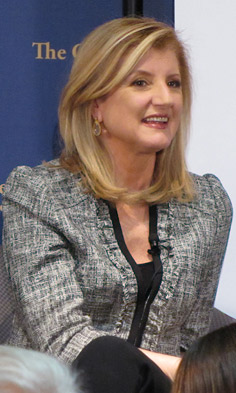 Disconnect between war spending and unemployment benefits
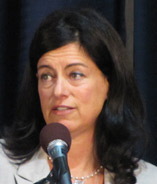 Laurie David, well known as the producer of ‘An Inconvenient Truth’, appeared at Climate One at the Commonwealth Club to talk about her new book, ‘The Family Dinner”.
 “Most of us in this room consume 150 times as much chicken as our grandparents did. And 99% of our meat and dairy comes directly to us from filthy factory farms that are devastating our air and water, and where animals are force fed food that is unnatural to their systems, pumped with hormones and antibiotics to make them get bigger faster so they can be slaughtered quicker and sold to us to keep up with the growing demand. That is what we are eating and feeding our kids”