‘An elderly Catholic nun and two peace activists have been convicted for damage they caused while breaking into a US nuclear defence site.’
via BBC News – Elderly nun convicted over US nuclear site break-in.

News: ‘General’ Archive
‘An elderly Catholic nun and two peace activists have been convicted for damage they caused while breaking into a US nuclear defence site.’
via BBC News – Elderly nun convicted over US nuclear site break-in.
‘A team of mathematicians, philosophers and scientists at Oxford University’s Future of Humanity Institute say there is ever-increasing evidence that the human race’s reliance on technology could, in fact, lead to its demise.’
via This is the end: Team of experts say humanity faces extinction | The Sideshow – Yahoo! News.
‘This boom, driven by low prices for natural gas—the main ingredient in ammonia production—will drive a corresponding surge in the industry’s already substantial carbon footprint.’
via Fertilizer Plants Spring Up to Take Advantage of U.S. s Cheap Natural Gas – Yahoo! News.
April 3, 2013, San Francisco
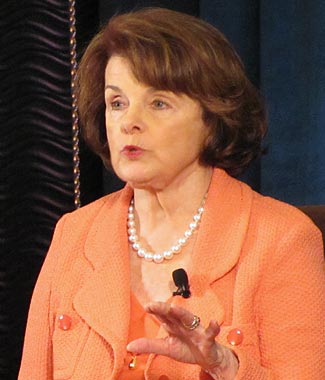
Democratic Senator Dianne Feinstein, chair of the Senate Intelligence Committee, appeared at ClimateOne at the Commonwealth Club to discuss several topics, including attempts to ban assault weapons, the use of drones, and climate change. This video features her comments related to energy and climate change. During her appearance, Feinstein repeatedly stressed the importance of taking action to avert climate change and spoke critically of the Keystone XL pipeline, yet paradoxically acknowledged in a follow up press conference that governmental action on climate change was “not on the high priority list”. She said she intends to introduce a $10/ton carbon tax bill, with half of proceeds to be used to pay down the national debt.
Senator Feinstein: “The climate has already warmed at least one degree over a hundred years. And you know, people I think don’t really understand. They think the earth is immutable, they think we can’t destroy it, that it’s here to stay, and that it’s always been this way. It’s not so. You know, some two hundred million plus years ago, there’s geologic evidence to say that maybe there was only one land mass on earth and it all split apart. I don’t know whether that’s true or false, I’ve read a lot of science on the subject.”
 |
| “The question is, can we really bite the bullet and make the decision that we’re going to save the planet, because if it warms … 4 to 7 degrees, it’s too late.” ~ Senator Dianne Feinstein |
“But ever since the industrial revolution when we began to pump carbon dioxide through fuel into the atmosphere. The atmosphere is very limited, it’s maybe seven miles up, and that’s it. And it’s like a shell. And so every bit of this that’s pumped into the atmosphere stays, it doesn’t dissipate. So as we fill the atmosphere with pollutants, methane, carbon dioxide, other things, what happens is, it warms the earth. And it begins with, animal habitat disappears, it begins with the ocean beginning to rise, it begins with more violent hurricanes, tornadoes, funnel clouds in the pacific, where in my youth they never used to be, they are now, on occasion. And, lightning strikes, I remember one June where there were thousands of lightning strikes that started hundreds of small fires in California. When it rains the drops are bigger, the rains more violent. Drought is more prevalent. So I think, actually, what’s going to be the ultimate changer, is weather.”
“People see weather, they see hurricanes, they see the devastation, and so I think eventually, people are going to come around to support restrictions on carbon dioxide, maybe a fee on the use of carbon that goes in to replace our deficit, our debt. A twenty dollar fee I think is like 1.2 trillion in revenue over ten years. If you just take half that, it’s 600 billion. And it accomplishes something.”
Greg Dalton: “Is there much support for that in the Senate?”
Senator Feinstein: “I wouldn’t say there’s much, I would say this – people are coming to realize now. And we have a little caucus that meets and discusses, we’ve had I think three global warming bills up, they didn’t get, I mean they got thirty six or so votes, but, everything’s getting worse. The weather is getting worse, and the climate change is getting worse. 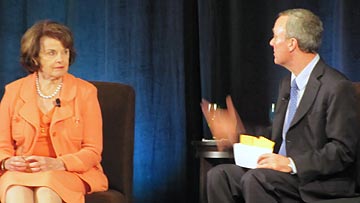 And actually since 2008, good energy has doubled, that’s the good thing. That you know electric cars are being more prevalent, hybrids are being more prevalent. People are saving money. So good things are happening, the question is, can we really bite the bullet and make the decision that we’re going to save the planet, because if it warms, and I heard your opening spot, 4 to 7 degrees, it’s too late. If we can confine this warming to one to two degrees, then, there’s big change, but it’s handle able. And that’s where we should strive to go. China in particular has a terrible, terrible problem. Deaths are now up from pollution. People are wearing masks virtually all winter long in Shanghai and Beijing.”
Greg Dalton: “And there’s been some recent reports putting price tags on all of that, the price of the health loss of life, etc. President Obama in his inaugural address and state of the Union pledged stronger action on climate. Do you think he’s doing enough? Specifically, what should he do?”
Senator Feinstein: “The President has so many things, and everybody says do you think he’s doing enough on this or that or the other thing, and he’s going to appoint a new EPA director. The EPA now has the ability to move ahead, so it’s very important that the EPA director be strong and be willing to take the action that’s necessary to help us all save this planet.”
Greg Dalton: “And you think Gina McCarthy will get confirmed?”
Senator Feinstein: “That’s a good question, everything is questioned these days. It’s the first time I have ever seen a president go through years of his presidency without being able to confirm members of his own cabinet.”
Greg Dalton: “And the judiciary?”
Senator Feinstein: “And the judiciary, well the judiciary is sort of a place apart. But for the executive branch to work, having your cabinet in place is a no brainer. You know, everybody says well elections matter, yes they matter. Whoever is president has to be able to govern and the way you govern is through your executives which are your cabinet secretaries.”

Greg Dalton: “Do you think the U.S. should approve the Keystone pipeline?”
Senator Feinstein: “I have just been reading a National Geographic article on tar sands, and everything I’ve seen in that article is bad. Now this tar sands project is up in Alberta. I’m told that the area is bigger than the state of Florida. I’m told that it’s a forested area which they mowed down and then began to dig the huge giant lakes, that they pour chemicals in to produce this form of tar sands oil. The earth is defaced forever. Now we have to make up our minds – do we want to deface large portions of our earth forever? I don’t think so, because we’re making progress on clean energy, and that ought to be where we go. And some people say well, you know, if that pipeline isn’t built north to south through the center of our country, they’re only going to do it east to west and send it to China. I think that is really not a very good argument because I think we really have to look at tar sands.”
Greg Dalton: “Another area of potential large oil development is here in California – the Monterey shale new fracking technologies making accessible about 15 billion barrels of oil which is equal to half the amount originally in the north slope of Alaska. Should that be developed and should California tax that? California is the only state that doesn’t tax oil extraction.”
Senator Feinstein: “Well I sure think we ought to tax it. Because I don’t think candidly that it’s all that necessary. There will be no drilling off the coast of California if Senator Boxer and I prevail, and we have so far. And the house delegation as well. The people of our state voted, and we voted against offshore oil drilling and I believe we ought to keep that vote. But my emphasis would be on clean energy, you know the wind farms, the solar facilities…and there’s so much research going on, on different forms of fuels. I’m amazed at what they think they can make fuel out of these days. So you know, I say, that’s just great, let’s do it. And leave these fossil fuels alone because they pollute the atmosphere.”
Water
“I spend a lot of my time on water in California. There is no question in my view that we are on our way to a much drier climate, we are on it because of global warming. We are on our way to the major source of water, which is the Sierra Nevada snow pack, drying up. And it’s very serious, and so there are big water fights. Right now the water allocation for south of Delta farmers I believe is 20% of their contract amount, that is way too little. A farmer can’t plant, irrigate and harvest with twenty percent of his contract amount. He probably can’t go to the banks and get the loans that he might need with twenty percent of his contract.”
National Security
 “If you have low lying areas, let’s take Bangladesh, let’s take some of the bigger islands, and they are flooded, where do people go, and what’s the result of that movement of people in low lying areas all over the world? What’s the result in oceans warming so that fishing stocks are killed or no longer as prevalent. So these are the kinds of national security concerns I think that emanate from that. And what was being done is having our satellites track various areas so that we could note changes over years- the melting arctic, the melting Antarctic. Greenland which is substantial melting, and from that you see the movement of people that’s gonna have to take place and then what happens with that. ”
Greg Dalton: “And some people are very concerned about Indonesia, largest Muslim country, heavily dependent on fishing. If fishing starts to go down in Indonesia, what does that mean for stability…”
Senator Feinstein: “That’s what I tried to say, I wasn’t as eloquent as you were.”
Greg Dalton: “Last question is, how do you think climate change will affect you and your family in years ahead?”
Senator Feinstein: “Well, I have seven grandchildren, and I really believe it will affect them. And I really hate to say this, but I spent forty years in this life in government, and to end it and not have secured a world that’s capable of sustenance and beauty and wonder for my grandchildren, is just a crushing blow. So, I hope that within the next six years, you’re going to see a climate change bill pass in the Senate and the House and be signed by this President.”
Q (press conference): “What action can we expect on climate change?”
Senator Feinstein: “I think that’s hard to predict right now. I think it’s not on the high priority list. I think that a carbon fee is growing in popularity. It’s my intention – I know there’s been a bill introduced at twenty dollars a ton, and it’s my intention to introduce one at ten dollars a ton, and we’ll see what happens to it.”
Report by James George
‘SAN DIEGO — Citing the danger to whales and other sea life, the California Coastal Commission voted unanimously Friday to reject the Navy’s plan for increased use of sonar and underwater explosives for training off Southern California.’
via Coastal panel rejects Navy’s plan to boost underwater blasts – latimes.com.
‘In Carlsbad, the nation’s largest desalination facility will require lots of energy — and money. It is expected to provide no more than a tenth of San Diego County ratepayers’ overall water supply.’
via Seawater desalination plant might be just a drop in the bucket – latimes.com.
‘SACRAMENTO — California environmental officials moved ahead with a first-ever auction of greenhouse gas pollution credits despite a last-minute lawsuit filed by the state Chamber of Commerce to invalidate the sale.’
via California holds cap-and-trade auction of greenhouse gas credits – latimes.com.
November 1, 2012, San Francisco
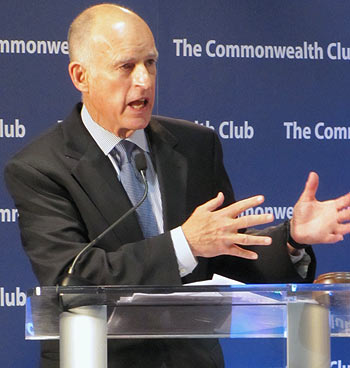
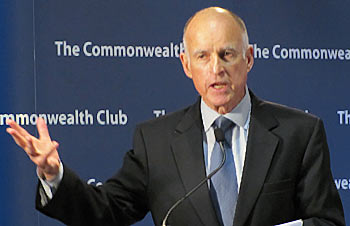
With less that a week to go before the election, California Governor Jerry Brown appeared at the Commonwealth Club in San Francisco to make his case for Proposition 30, which would provide funding for public education at a time when the state is facing major education cutbacks. This video features Governor Brown’s opening statement, which was followed with answers to audience questions read by the moderator Joseph Fink. The crowd appeared to enjoy the Governor’s varied and entertaining oratory, one moment speaking as a passionate political spokesman, the next as a blunt hard nosed budget negotiator, occasionally joking and providing comic relief, and at other times speaking with a sermon-like quality, referring to his time in seminary and making the moral case for a more equitable society.
 |
| “We face not only a political question, not only an economic question, but a moral question. Our society is held together by the contributions of all of us.” ~ Jerry Brown |
 |
| “We don’t stay on top by disinvesting in our schools, by disinvesting in our colleges and great University of California. The case for proposition 30 is crystal clear. Invest in the California dream. Keep the creativity and the innovation alive and well, and expanding and intensifying” |
 |
| “This is a vibrant, creative place. One of the most extraordinary pieces of real estate and collection of human beings in the whole world. Our exports are up 17% to 108 billion. Venture capital investment in California is half of what the rest of the country gets and of course we’re leading it in the clean tech investment and the clean tech production. Patents are issued in California at four times the rate of the next state which is New York.” ~ Governor Jerry Brown |
 |
| “California’s on the move again, adding jobs and investment in our state at a higher rate. We have to build for the future to insure that growth. This means temporary revenue to invest in our schools.” ~ Governor Brown |
“Looking back to my seminary education, I refer to Saint Luke who said in his gospel, chapter 12, verse 48, ‘to those to whom much is given, much is required’. We face not only a political question, not only an economic question, but a moral question. Our society is held together by the contributions of all of us, all 38 million. We all do what we can so each of us, do what we can, and for those who have been most blessed, we’re going to ask you for seven years. The biblical seven years. Lean years, fat years, you’ve had ’em both. So now as we face this difficult period ahead, I believe proposition 30 comes at just the right time with just the right formula. That’s the case for prop 30. It’s pretty simple. ”
“I can reduce it even more summarily, and that is, money into the schools and colleges, into the California dream, or out. In or out, yes or no, on or off, there’s no middle way. Or, if I can quote my Latin, tertsium non datum. A third way is not given. It’s yes or no.”
“In sum, we cleaned up a big budget mess, and now we have a structurally balanced budget for the first time in a decade. By California putting our fiscal house in order, we’ve been upgraded by the rating agencies. They’re now saying we’re positive. We’ve lowered our borrowing cost, and California’s on the move again, adding jobs and investment in our state at a higher rate. We have to build for the future to insure that growth. This means temporary revenue to invest in our schools.”
report by James George
October 25, 2012, San Francisco
A panel of experts discussed California’s proposition 37 which would require foods containing genetically modified organisms to be labeled. Ken Cook, President of the Environmental Working Group and Jessica Lundberg of Lundberg Family Farms argued in favor of requiring GMO labeling, and Dr. Kent Bradford, Director of the Seed Biotechnology Center at UC Davis, and Jesus Arredondo, founder of Advantage Government Consulting LLC argued against the proposition. Greg Dalton was the moderator.
Transcript of Selected Excerpts
Greg Dalton: “Ken Cook, why do you support proposition 37?”
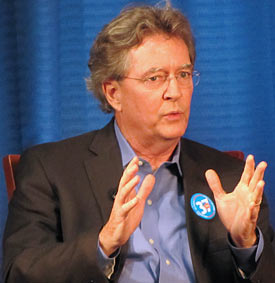 |
| “I’m very worried that so much power and so much money is concentrated in these big companies to the point that they can not only buy the technology and dictate how it’s going to be used, they’re coming very close – if we don’t fight back here in California – they’re coming very close to buying our right to know.” ~ Ken Cook |
Ken Cook 0:43 “The future of food is in California, and that future critically requires a right to know, transparency. Proposition 37 is premised on that very principle, that with the uncertainty that I think is out there about genetically engineered food. I do believe that we should have had from the very beginning government mandated health and safety studies. We do not. I do believe that we should have been much more rigorous in looking at what the downsides might be for the environment. We now have abundant evidence that there are major downsides to the introduction of these crops and the technologies that go with them which mostly are pesticides. The GMOs, the genetically engineered ingredients on the market, come to us now mostly from pesticide companies. And from my standpoint, there are uncertainties about the health and safety of genetically engineered ingredients. And while those uncertainties are out there, while the scientific debate proceeds, and we hope it will be rigorous. The American Medical Association has called for long term health and safety studies in a break from their past position recently. Until we have more resolution there, it’s the least we can do, is to give people the right to know, let them look at a label, and that’s what this proposition would do. If it’s whole food that’s genetically engineered it will say genetically engineered. If it’s a fruit or a vegetable. If it’s a processed ingredient, somewhere on the label, and these labels change all the time, it will have to indicate that there are genetically engineered ingredients in it. It’s very straightforward. And in California, we value those rights. And come to learn, you’ve been leading the nation for a long time in asserting those rights in the public interest. This is the right that we need now for our food.”
Greg Dalton: “Kent Bradford, why are you opposed to proposition 37?”
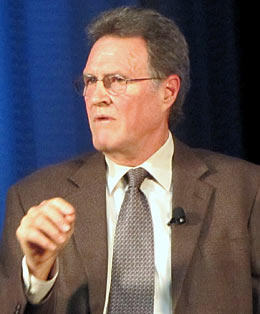 |
| “There are severe consequences to not having high productivity, high efficiency agriculture.” ~ Kent Bradford |
Kent Bradford 2:25 “The primary reason I’m opposed to it is, contrary to what we’ve just heard, there really is no scientific evidence that they’re harmful at all or that there’s any danger to them whatsoever. In fact just today, the American Association for the Advancement of Science, the biggest organization of scientists in the world, came out and reiterated that there is no scientific reason to specially label these crops or be concerned about their safety, simply because they’re genetically engineered. One of the main problems with the labeling initiative, 37, is that it is labeling for an entire technology. It in fact says that you will not label for the actual ingredient in the food, so in fact we’re using a very broad stroke, we’re labeling all foods that might have used genetic engineering. The American Medical Association just in June this year very clearly said, there is no scientific justification for labeling of bioengineered foods. So, I could go on about scientific organizations. Every reputable scientific organization has concluded that there really is none. The products on the market that have been produced using genetic engineering have all been through FDA review. It’s true as was stated it’s not mandated. It’s not mandated for any whole food in the U.S. All of the reviews of whole foods by the FDA are voluntary. Every genetically engineered food in the market today has been through the FDA review, so in fact there is no worries there. So overall, as a scientist my view is that we need these tools, contrary to what you’ve just heard, the use of genetic engineering is reducing pesticide use, particularly insecticide use has gone down dramatically. It has shifted the use of other crop agriculture chemicals like herbicides to much much safer chemicals to what was used previously. So it has replaced other chemicals that were worse, and so the overall environmental impact quotient has gone down by about 18% due to the use of these crops. So I really don’t feel like we need to add a stigmatizing label to these foods when in fact they are beneficial for us and the environment. There is absolutely no evidence that there is a health problem, and the label itself would be so vague that in fact it would be actually useless to the consumer other than just to label virtually every processed food on the market. Those are some of the reasons that I don’t think you should vote for it.”
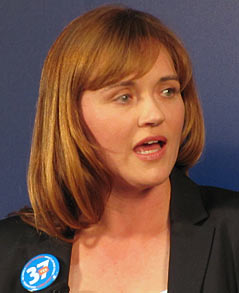 |
| “The vast majority of the crops that are being engineered are for herbicide tolerance or they are actually being engineered to be pesticides themselves, to be toxic to insects.” ~ Jessica Lundberg |
Jessica Lundberg 5:49 “The research that we’ve been seeing is that there’s over 500 million pounds more pesticides being used since the introduction of these genetically engineered crops, and these pesticides have to go somewhere, they’re going into the soil the air and the water. ..The vast majority of the crops that are being engineered are for herbicide tolerance or they are actually being engineered to be pesticides themselves, to be toxic to insects. We were promised a technology that would reduce the amount of chemicals being used and actually we have seen an increase in chemicals, just like we were promised a technology that would increase yields for farmers and have health benefits for consumers, and we have not seen an increase in yields and we have not seen any health benefits for consumers….”
6:45 “They are seeing in the areas where you’re using these herbicide resistant crops that… it’s what you knew would happen, that the more you use a chemical, the more the weed species adapt, and so as the weed species adapt you have to use more chemicals, and this in some areas has meant more applications of the chemicals, it’s also meant more chemicals of different spectrums, different types of chemicals, to address the weeds that aren’t addressed with the chemical that the plant is engineered to withstand.”
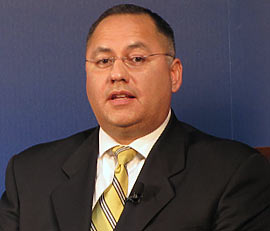 |
| “The way that this proposition is drafted is very poor and will result in enormous confusion, and it’s going to increase the costs for our foods” ~ Jesus Arredondo |
Jesus Arredondo 7:28 “The principle concerns I have, I spend most of my time on regulation, and I think the approach to better information and providing more information to a society – it’s a noble goal, it’s a noble start – unfortunately the way that this proposition is drafted is very poor and will result in enormous confusion, and it’s going to increase the costs for our foods. The unfortunate reality here is that you have a proposition that is so poorly worded that we are going to wind up in litigation on day one if this thing passes. I would say vote no.”
Ken Cook 13:25 “Look I just think you have to face the facts here. Labeling is required in over fifty countries around the world. …They’re selling the same products over there that they sell here and that they would be selling in California except they’re required to label genetically engineered food that’s point one and there’s been no cost increases that they’ve reported whatsoever ’cause the food companies have responded.”
 |
| “We know from Amartya Sen’s Nobel prize that people don’t starve primarily ’cause there’s a lack of food, it’s ’cause they don’t have access to it, they can’t buy it” ~ Ken Cook |
Genetically Engineered Salmon
Greg Dalton 30:50: “One related issue is genetically engineered salmon. Senator Lisa Murkowski, a republican senator from Alaska, had a bill in the senate earlier to require comprehensive environmental study before government approval to get into the food supply. This would apparently be the first GE animal for human consumption. That lost in the senate, would that be something – I’d like to ask Kent or Jesus – you would support?”
Kent Bradford 31.59: “I don’t see any problem with that fish myself. I have to say. What they’ve done is they’ve created a fish that will grow three times bigger on the same amount of feed in a shorter time. And now they’ve moved it entirely to inland production. That is it’s not even being asked whether your growing anywhere near the ocean. It’s going to be completely inland production so there’ll be no possibility of escape. It’s the same fish, it just grows faster. I mean, I’ll be frankly honest, we need to do that with crops, we need to be doing that a lot. Because we have to increase productivity per unit area of land, or else we’re going to take over more land and we don’t have it. I mean there are severe consequences to not having high productivity, high efficiency agriculture.”
Greg Dalton: “And we have to feed 9 Billion people by mid century, Ken Cook?”
Ken Cook 32:06 “Well, and there’s lots of ways we can feed those people, and we know from Amartya Sen’s Nobel prize that people don’t starve primarily ’cause there’s a lack of food, it’s ’cause they don’t have access to it, they can’t buy it.”
Ken Cook 32:20 “The biotechnology industry crushed Republican Senator Murkowski ‘s amendment that just asked for a more thorough environmental study. If it’s the case as you just described Kent that it’s no big deal that ought to be a pretty easy study to do. But see, she represents salmon fishermen in Alaska she’s concerned about this. And she went to her colleagues on the Senate floor and she asked can we just proceed with a study that’s more rigorous than we were going to do otherwise, as we’re going through the approval process of this. And time and again the industry you’re representing up here today, you’re standing up for which is not the public institutions, it’s the pesticide companies and the other biotech firms that make this stuff, they have fought time and time again to delimit as much as they can any kind of health and safety studies and overviews, and only when they lose those fights do they – as they did in the case of making some of the material more available to researchers… somewhat more available – only then do they come forward and accept a different regime. They’ve spent a lot of money, they’re spending over $40,000,000 to kill prop 37 in our state, over $40 million bucks, with advertisements that are making – talk about sloppily written and deceptive labels – these advertisements are the epidemy of it. And this is a great example. Just do that study, and they just couldn’t stand for it. Just do labeling, they just can’t stand for it. Require health and safety testing at the federal level like we do for pesticides and other things – no. ”
Audience Q: 35:43 “Perhaps a similar question, it’s about maybe the hubris of science. Nuclear power was claimed it would be safe and too cheap to meter, it wasn’t. So what about this – not just as a consumer issue for the health of the consumer, that we can track in a relatively short time frame – but what in ten thousand years, a hundred thousand years. We’re introducing things, is there enough exploration to know, and can we trust a corporation that’s looking at a quarterly profit sheet to introduce something that could be around, well, beyond our time scale?”
Kent Bradford 36:15 “I’ll just say one thing about it going out, will it be a hundred thousand years from now will it be a problem. Let me tell you, while were here tonight, a thousand kids will die of malnourishment… Genetic engineering was used to create golden rice that has vitamin A in it. It’s being stymied by the same types of arguments that we’re hearing up here tonight, that it might something somewhere might go wrong. So I’ll leave it to you people what’s the moral choice here, should we give that rice, a cup of this rice everyday to kids, would solve malnutrition, not make ’em go blind, solve their malnutrition issue. Should we continue to stigmatize this technology, so that people can have the choice between fantastic organic food, fantastic GMO free food, or fantastic conventional food… you make the choice. ”
Ken Cook 37:11 “You make a good point. First of all, there are other ways to get vitamin A to these kids, and I’m not even saying that in the case of this rice that it should not be put on the market, but I think that people ought to know when it is and make a decision about it. And look, you know, the questioner asked about these big companies. Dupont and Monsanto, they’ve made a lot of chemicals that are no longer on the market. And they’re no longer on the market because when we finally got around to understanding their health and safety impacts the government had to take action and take them off the market. Those are regulatory systems in place that have that power. Right now we’re not collecting the kind of information that would allow a regulatory agency to really I think do an impartial review of health and safety, and I think that’s what we’re asking for in the long term. But that’s not what’s on the ballot here in California. What’s on the ballot here is really simple. If it’s genetically engineered, it says genetically engineered. It doesn’t say ‘danger’ genetically engineered, it doesn’t say ‘warning’ genetically engineered. It just says genetically engineered.”
Ken Cook 38:59 “I would like to see more public research on the genetic engineering of crops. I would like to see more public research into the potential impacts of it. I’m very worried that so much power as you say and so much money is concentrated in these big companies to the point that they can not only buy the technology and dictate how it’s going to be used, they’re coming very close, if we don’t fight back here in California, they’re coming very close to buying our right to know.”
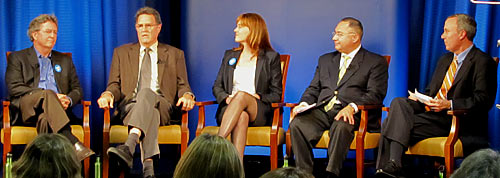 |
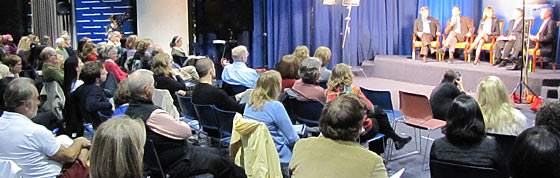
| Panel discussion at the Commonwealth Club in San Francisco |
Report by James George
July 11, 2012 San Francisco
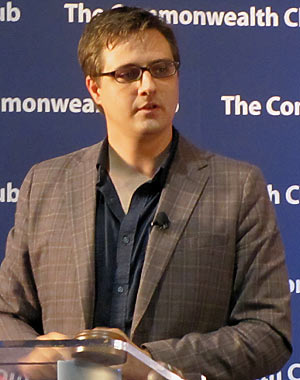
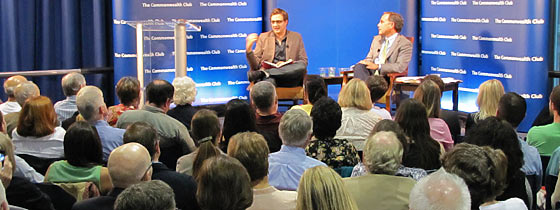
Chris Hayes, editor at large of the Nation and host of MSNBC’s UP w/ Chris Hayes appeared before a packed audience at the Commonwealth Club to talk about his recent book Twilight of the Elites: America After Meritocracy. The talk lasted about an hour and was followed by a book signing.
 |
| ‘It is trickier than it looks to produce a system with huge rewards for performance that is not also a system with huge rewards for cheating.’ ~ Chris Hayes |
Report by James George