
Oct 23, 2009 Berkeley, CA.
 Carten Hein Westergaard, of Vestas Technology R& D Americas, Inc., spoke at the Univeristy of California Berkeley today on wind power – or more accurately, Vestas and wind power.
Vestas is a longstanding major player in the wind energy business, boasting 20% of the global market, some 4000 employees, $595 million in investments, and 39,000 wind turbines installed to date. One Vestas V90-3MW turbine was said to be capable of producing an equivalent energy to 7,582 barrels of oil annually. Denmark, global home to Vestas, is now producing 20% of their energy with wind turbines. With the green revolution in full swing, Vestas is installing an average of one new turbine every four hours.
The pace of that production schedule is impression just given the sheer magnitude of these machines. The rotor alone weighs 41 tonnes, the nazelle, 70 tonnes, and the tower a whopping 285 tonnnes. A slide of a train with a long string of cars fully loaded with enourmous turbine components clearly made the point of just how substantial an undertaking it is to transport and assemble these massive structures.
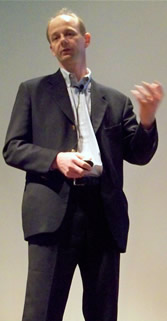 Wind turbines look relatively simple from a distance, but Westergaard pointed out there are real engineering challenges to assembling, installing and maintaining wind turbines with a twenty year lifespan. In real world conditions, they face multiple and ongoing stresses, including such things as lightning and gale winds which can reach 32 meters/sec. To service the turbines, Carsten showed an image of an interesting craneless device somewhat akin to the way people climb coconut trees.
Nevertheless, Westergaard said the main impediment to rapid growth in wind power is not turbine engineering, but rather limits in the existing transmission line infrastructure. These limits will need to be addressed as the United States and Europe struggle to achieve increasingly ambitious clean energy goals. By 2007, Europe had installed 56 gigawatts of wind power capacity, including 1gigawatts offshore. Their annual investment is on the order of $156 million. Westergaard said in the United States the DOE is plannning to reach 300 gigawatts by 2030, including 54 gigawatts of offshore wind energy.
While interesting and informative, there are inherent limits to presentations like this by corporate representatives, since they serve the two goals of educating the public on pressing societal problems while simultaneously promoting the approach and image of the company being represented – and all the while remaining cautious not to compromise trade secrets.
For example, even though a video of the entire talk and slideshow will soon be publically available online, as press I was not even allowed to take photos of the rather generic and non-revealing slideshow. This sort of propriatory restrictiveness is out of place in a public lecture at Berkeley, a publically funded university which also happens to be famous as the birthplace of the free speech movement. In Berkeley, concerns about corporate influence in the public sphere came to the fore in recent years over BP’s $500 million funding for biofuels research.
Many in the green circles many would choose to emphasize the distinction between clean wind and dirty GHG emitting fossil fuels, yet Vestas takes an entirely different approach with their “Wind, Oil and Gas” slogan. From Vestas’ website:
“The Wind, Oil and Gas vision expresses Vestas’ ambition of assuming leadership in the efforts to make wind an energy source on a par with fossil fuels.” The goal is to make wind power mainstream.
Vestas and wind energy are by no means without controversy. Many familiar issues such as workers rights, plant closings, and globalization come into play as big companies struggle to compete in turbulent markets. Recently there were demonstrations over a Vestas blade manufacturing plant closure in England.
Article by James George
 "I believe that people around the world have a right to know exactly what their governments will do to address dangerous climate change. And this session has shown that it can be done, all the ingredients for success are on the table, and what we must do now is step back from self interest and let common interest prevail.