‘Evidence of abundant rainfall early in the Maya civilization and drought later could explain its fate, scientists suggest.’
via Climate change may explain Maya rise and fall, study says – latimes.com.

News Roundup
‘Evidence of abundant rainfall early in the Maya civilization and drought later could explain its fate, scientists suggest.’
via Climate change may explain Maya rise and fall, study says – latimes.com.
‘Writing in the journal PLoS One on Wednesday, research botanist Aaron Davis of the Royal Botanic Gardens, Kew in London and colleagues reported that climate warming could drive wild varieties of Coffea arabica to extinction by 2080.’
‘…Eric Pooley … offers a baseball analogy: “We can’t say that steroids caused any one home run by Barry Bonds, but steroids sure helped him hit more and hit them farther. Now we have weather on steroids.”.
‘While there was little talk of climate change during the presidential campaign, the number of U.S. voters who see global warming as a serious problem is at an all-time high.’
‘Advocates for geothermal energy say that the path of destruction cut by Hurricane Sandy, which unearthed fuel tanks, ravaged cooling towers and battered air-conditioners, has already persuaded some building owners to switch to geothermal systems that use underground pipes to harness the earth’s energy for heating and cooling buildings.’
via Geothermal Energy Advocates Hope Systems Get a Second Look – NYTimes.com.
‘Researchers have developed a way to enhance the energy produced by biofuels, potentially expanding their usefulness in jet planes and industrial vehicles.’
via Chemical approach drastically improves power of biofuels – latimes.com.
‘Coming on the heels of this summer’s crop-withering drought in the Midwest and destructive wildfires in the West, Sandy provided a glimpse of what scientists say the nation can expect with global warming. Even before surging floodwaters choked Manhattan subway tunnels and left parts of the Jersey Shore in shambles, public acceptance of climate change was growing.’
via Sandy a galvanizing moment for climate change? – latimes.com.
November 1, 2012, San Francisco
With less that a week to go before the election, California Governor Jerry Brown appeared at the Commonwealth Club in San Francisco to make his case for Proposition 30, which would provide funding for public education at a time when the state is facing major education cutbacks. This video features Governor Brown’s opening statement, which was followed with answers to audience questions read by the moderator Joseph Fink. The crowd appeared to enjoy the Governor’s varied and entertaining oratory, one moment speaking as a passionate political spokesman, the next as a blunt hard nosed budget negotiator, occasionally joking and providing comic relief, and at other times speaking with a sermon-like quality, referring to his time in seminary and making the moral case for a more equitable society.
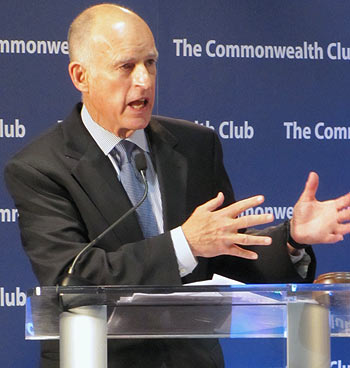 |
| “We face not only a political question, not only an economic question, but a moral question. Our society is held together by the contributions of all of us.” ~ Jerry Brown |
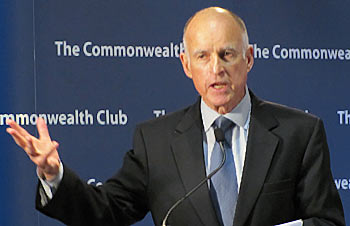 |
| “We don’t stay on top by disinvesting in our schools, by disinvesting in our colleges and great University of California. The case for proposition 30 is crystal clear. Invest in the California dream. Keep the creativity and the innovation alive and well, and expanding and intensifying” |
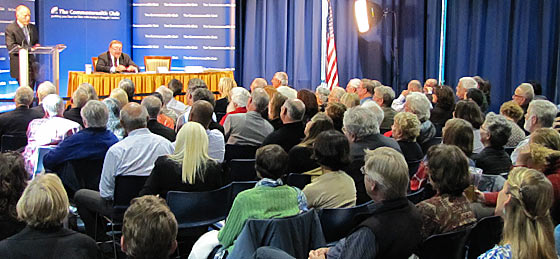 |
| “This is a vibrant, creative place. One of the most extraordinary pieces of real estate and collection of human beings in the whole world. Our exports are up 17% to 108 billion. Venture capital investment in California is half of what the rest of the country gets and of course we’re leading it in the clean tech investment and the clean tech production. Patents are issued in California at four times the rate of the next state which is New York.” ~ Governor Jerry Brown |
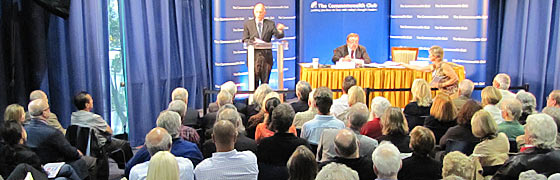 |
| “California’s on the move again, adding jobs and investment in our state at a higher rate. We have to build for the future to insure that growth. This means temporary revenue to invest in our schools.” ~ Governor Brown |
“Looking back to my seminary education, I refer to Saint Luke who said in his gospel, chapter 12, verse 48, ‘to those to whom much is given, much is required’. We face not only a political question, not only an economic question, but a moral question. Our society is held together by the contributions of all of us, all 38 million. We all do what we can so each of us, do what we can, and for those who have been most blessed, we’re going to ask you for seven years. The biblical seven years. Lean years, fat years, you’ve had ’em both. So now as we face this difficult period ahead, I believe proposition 30 comes at just the right time with just the right formula. That’s the case for prop 30. It’s pretty simple. ”
“I can reduce it even more summarily, and that is, money into the schools and colleges, into the California dream, or out. In or out, yes or no, on or off, there’s no middle way. Or, if I can quote my Latin, tertsium non datum. A third way is not given. It’s yes or no.”
“In sum, we cleaned up a big budget mess, and now we have a structurally balanced budget for the first time in a decade. By California putting our fiscal house in order, we’ve been upgraded by the rating agencies. They’re now saying we’re positive. We’ve lowered our borrowing cost, and California’s on the move again, adding jobs and investment in our state at a higher rate. We have to build for the future to insure that growth. This means temporary revenue to invest in our schools.”
report by James George
‘Hurricane Sandy’s devastating intrusion into the final days of the presidential race would have at least one positive result if it inspired President Obama and Mitt Romney to finally address a huge issue they have ignored throughout the long campaign: climate change.’
via Will Obama and Romney see climate change in Hurricane Sandy? – latimes.com.
October 25, 2012, San Francisco
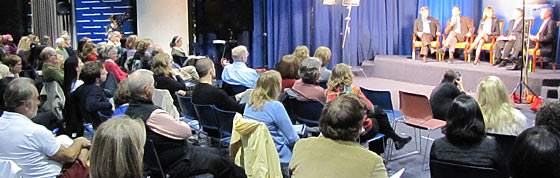
A panel of experts discussed California’s proposition 37 which would require foods containing genetically modified organisms to be labeled. Ken Cook, President of the Environmental Working Group and Jessica Lundberg of Lundberg Family Farms argued in favor of requiring GMO labeling, and Dr. Kent Bradford, Director of the Seed Biotechnology Center at UC Davis, and Jesus Arredondo, founder of Advantage Government Consulting LLC argued against the proposition. Greg Dalton was the moderator.
Transcript of Selected Excerpts
Greg Dalton: “Ken Cook, why do you support proposition 37?”
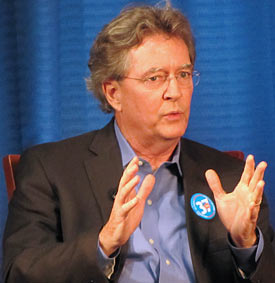 |
| “I’m very worried that so much power and so much money is concentrated in these big companies to the point that they can not only buy the technology and dictate how it’s going to be used, they’re coming very close – if we don’t fight back here in California – they’re coming very close to buying our right to know.” ~ Ken Cook |
Ken Cook 0:43 “The future of food is in California, and that future critically requires a right to know, transparency. Proposition 37 is premised on that very principle, that with the uncertainty that I think is out there about genetically engineered food. I do believe that we should have had from the very beginning government mandated health and safety studies. We do not. I do believe that we should have been much more rigorous in looking at what the downsides might be for the environment. We now have abundant evidence that there are major downsides to the introduction of these crops and the technologies that go with them which mostly are pesticides. The GMOs, the genetically engineered ingredients on the market, come to us now mostly from pesticide companies. And from my standpoint, there are uncertainties about the health and safety of genetically engineered ingredients. And while those uncertainties are out there, while the scientific debate proceeds, and we hope it will be rigorous. The American Medical Association has called for long term health and safety studies in a break from their past position recently. Until we have more resolution there, it’s the least we can do, is to give people the right to know, let them look at a label, and that’s what this proposition would do. If it’s whole food that’s genetically engineered it will say genetically engineered. If it’s a fruit or a vegetable. If it’s a processed ingredient, somewhere on the label, and these labels change all the time, it will have to indicate that there are genetically engineered ingredients in it. It’s very straightforward. And in California, we value those rights. And come to learn, you’ve been leading the nation for a long time in asserting those rights in the public interest. This is the right that we need now for our food.”
Greg Dalton: “Kent Bradford, why are you opposed to proposition 37?”
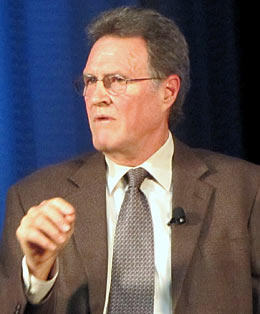 |
| “There are severe consequences to not having high productivity, high efficiency agriculture.” ~ Kent Bradford |
Kent Bradford 2:25 “The primary reason I’m opposed to it is, contrary to what we’ve just heard, there really is no scientific evidence that they’re harmful at all or that there’s any danger to them whatsoever. In fact just today, the American Association for the Advancement of Science, the biggest organization of scientists in the world, came out and reiterated that there is no scientific reason to specially label these crops or be concerned about their safety, simply because they’re genetically engineered. One of the main problems with the labeling initiative, 37, is that it is labeling for an entire technology. It in fact says that you will not label for the actual ingredient in the food, so in fact we’re using a very broad stroke, we’re labeling all foods that might have used genetic engineering. The American Medical Association just in June this year very clearly said, there is no scientific justification for labeling of bioengineered foods. So, I could go on about scientific organizations. Every reputable scientific organization has concluded that there really is none. The products on the market that have been produced using genetic engineering have all been through FDA review. It’s true as was stated it’s not mandated. It’s not mandated for any whole food in the U.S. All of the reviews of whole foods by the FDA are voluntary. Every genetically engineered food in the market today has been through the FDA review, so in fact there is no worries there. So overall, as a scientist my view is that we need these tools, contrary to what you’ve just heard, the use of genetic engineering is reducing pesticide use, particularly insecticide use has gone down dramatically. It has shifted the use of other crop agriculture chemicals like herbicides to much much safer chemicals to what was used previously. So it has replaced other chemicals that were worse, and so the overall environmental impact quotient has gone down by about 18% due to the use of these crops. So I really don’t feel like we need to add a stigmatizing label to these foods when in fact they are beneficial for us and the environment. There is absolutely no evidence that there is a health problem, and the label itself would be so vague that in fact it would be actually useless to the consumer other than just to label virtually every processed food on the market. Those are some of the reasons that I don’t think you should vote for it.”
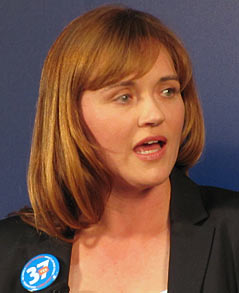 |
| “The vast majority of the crops that are being engineered are for herbicide tolerance or they are actually being engineered to be pesticides themselves, to be toxic to insects.” ~ Jessica Lundberg |
Jessica Lundberg 5:49 “The research that we’ve been seeing is that there’s over 500 million pounds more pesticides being used since the introduction of these genetically engineered crops, and these pesticides have to go somewhere, they’re going into the soil the air and the water. ..The vast majority of the crops that are being engineered are for herbicide tolerance or they are actually being engineered to be pesticides themselves, to be toxic to insects. We were promised a technology that would reduce the amount of chemicals being used and actually we have seen an increase in chemicals, just like we were promised a technology that would increase yields for farmers and have health benefits for consumers, and we have not seen an increase in yields and we have not seen any health benefits for consumers….”
6:45 “They are seeing in the areas where you’re using these herbicide resistant crops that… it’s what you knew would happen, that the more you use a chemical, the more the weed species adapt, and so as the weed species adapt you have to use more chemicals, and this in some areas has meant more applications of the chemicals, it’s also meant more chemicals of different spectrums, different types of chemicals, to address the weeds that aren’t addressed with the chemical that the plant is engineered to withstand.”
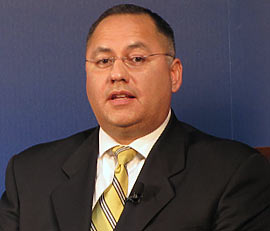 |
| “The way that this proposition is drafted is very poor and will result in enormous confusion, and it’s going to increase the costs for our foods” ~ Jesus Arredondo |
Jesus Arredondo 7:28 “The principle concerns I have, I spend most of my time on regulation, and I think the approach to better information and providing more information to a society – it’s a noble goal, it’s a noble start – unfortunately the way that this proposition is drafted is very poor and will result in enormous confusion, and it’s going to increase the costs for our foods. The unfortunate reality here is that you have a proposition that is so poorly worded that we are going to wind up in litigation on day one if this thing passes. I would say vote no.”
Ken Cook 13:25 “Look I just think you have to face the facts here. Labeling is required in over fifty countries around the world. …They’re selling the same products over there that they sell here and that they would be selling in California except they’re required to label genetically engineered food that’s point one and there’s been no cost increases that they’ve reported whatsoever ’cause the food companies have responded.”
 |
| “We know from Amartya Sen’s Nobel prize that people don’t starve primarily ’cause there’s a lack of food, it’s ’cause they don’t have access to it, they can’t buy it” ~ Ken Cook |
Genetically Engineered Salmon
Greg Dalton 30:50: “One related issue is genetically engineered salmon. Senator Lisa Murkowski, a republican senator from Alaska, had a bill in the senate earlier to require comprehensive environmental study before government approval to get into the food supply. This would apparently be the first GE animal for human consumption. That lost in the senate, would that be something – I’d like to ask Kent or Jesus – you would support?”
Kent Bradford 31.59: “I don’t see any problem with that fish myself. I have to say. What they’ve done is they’ve created a fish that will grow three times bigger on the same amount of feed in a shorter time. And now they’ve moved it entirely to inland production. That is it’s not even being asked whether your growing anywhere near the ocean. It’s going to be completely inland production so there’ll be no possibility of escape. It’s the same fish, it just grows faster. I mean, I’ll be frankly honest, we need to do that with crops, we need to be doing that a lot. Because we have to increase productivity per unit area of land, or else we’re going to take over more land and we don’t have it. I mean there are severe consequences to not having high productivity, high efficiency agriculture.”
Greg Dalton: “And we have to feed 9 Billion people by mid century, Ken Cook?”
Ken Cook 32:06 “Well, and there’s lots of ways we can feed those people, and we know from Amartya Sen’s Nobel prize that people don’t starve primarily ’cause there’s a lack of food, it’s ’cause they don’t have access to it, they can’t buy it.”
Ken Cook 32:20 “The biotechnology industry crushed Republican Senator Murkowski ‘s amendment that just asked for a more thorough environmental study. If it’s the case as you just described Kent that it’s no big deal that ought to be a pretty easy study to do. But see, she represents salmon fishermen in Alaska she’s concerned about this. And she went to her colleagues on the Senate floor and she asked can we just proceed with a study that’s more rigorous than we were going to do otherwise, as we’re going through the approval process of this. And time and again the industry you’re representing up here today, you’re standing up for which is not the public institutions, it’s the pesticide companies and the other biotech firms that make this stuff, they have fought time and time again to delimit as much as they can any kind of health and safety studies and overviews, and only when they lose those fights do they – as they did in the case of making some of the material more available to researchers… somewhat more available – only then do they come forward and accept a different regime. They’ve spent a lot of money, they’re spending over $40,000,000 to kill prop 37 in our state, over $40 million bucks, with advertisements that are making – talk about sloppily written and deceptive labels – these advertisements are the epidemy of it. And this is a great example. Just do that study, and they just couldn’t stand for it. Just do labeling, they just can’t stand for it. Require health and safety testing at the federal level like we do for pesticides and other things – no. ”
Audience Q: 35:43 “Perhaps a similar question, it’s about maybe the hubris of science. Nuclear power was claimed it would be safe and too cheap to meter, it wasn’t. So what about this – not just as a consumer issue for the health of the consumer, that we can track in a relatively short time frame – but what in ten thousand years, a hundred thousand years. We’re introducing things, is there enough exploration to know, and can we trust a corporation that’s looking at a quarterly profit sheet to introduce something that could be around, well, beyond our time scale?”
Kent Bradford 36:15 “I’ll just say one thing about it going out, will it be a hundred thousand years from now will it be a problem. Let me tell you, while were here tonight, a thousand kids will die of malnourishment… Genetic engineering was used to create golden rice that has vitamin A in it. It’s being stymied by the same types of arguments that we’re hearing up here tonight, that it might something somewhere might go wrong. So I’ll leave it to you people what’s the moral choice here, should we give that rice, a cup of this rice everyday to kids, would solve malnutrition, not make ’em go blind, solve their malnutrition issue. Should we continue to stigmatize this technology, so that people can have the choice between fantastic organic food, fantastic GMO free food, or fantastic conventional food… you make the choice. ”
Ken Cook 37:11 “You make a good point. First of all, there are other ways to get vitamin A to these kids, and I’m not even saying that in the case of this rice that it should not be put on the market, but I think that people ought to know when it is and make a decision about it. And look, you know, the questioner asked about these big companies. Dupont and Monsanto, they’ve made a lot of chemicals that are no longer on the market. And they’re no longer on the market because when we finally got around to understanding their health and safety impacts the government had to take action and take them off the market. Those are regulatory systems in place that have that power. Right now we’re not collecting the kind of information that would allow a regulatory agency to really I think do an impartial review of health and safety, and I think that’s what we’re asking for in the long term. But that’s not what’s on the ballot here in California. What’s on the ballot here is really simple. If it’s genetically engineered, it says genetically engineered. It doesn’t say ‘danger’ genetically engineered, it doesn’t say ‘warning’ genetically engineered. It just says genetically engineered.”
Ken Cook 38:59 “I would like to see more public research on the genetic engineering of crops. I would like to see more public research into the potential impacts of it. I’m very worried that so much power as you say and so much money is concentrated in these big companies to the point that they can not only buy the technology and dictate how it’s going to be used, they’re coming very close, if we don’t fight back here in California, they’re coming very close to buying our right to know.”
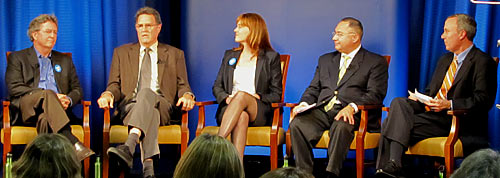 |
| Panel discussion at the Commonwealth Club in San Francisco |
Report by James George