
‘…The candidates are not simply rejecting solutions, like putting a price on carbon, though these, too, are demonized. They are re-running the strategy of denial perfected by Mr. Cheney a decade ago, repudiating years of peer-reviewed findings about global warming and creating an alternative reality in which climate change is a hoax or conspiracy.’
News Roundup
Editorial – In Climate Denial, Again – NYTimes.com
October 18th, 2010Video: Secretary Clinton at the Commonwealth Club, Opening Statement
October 17th, 2010October 15, 2010 San Francisco
Secretary of State Hillary Rodham Clinton began her appearance at ClimateOne at the Commonwealth Club with an opening statement. This video includes excerpts of her address:
Partial Transcription:
“I wanted to just make a few points, because I think it’s important to give you a bit of an overview of what we’ve been trying to do since January 2009. Clearly for me as Secretary of State it is a primary mission to elevate diplomacy and development alongside defense so that we have an integrated foreign policy in support of our national security, and in furtherance of our interests and our values. Now that seems self evident when I say it tonight here in this gathering, but it is actually quite challenging to do. It’s challenging for several reasons, first because the diplomacy of our nation which has been from the very beginning one of the principle tools of what we do has never been fully understood by the general public. It appears in the minds of many to be official meetings mostly conducted by men in three piece suits with other men in government buildings and even palaces to end wars and resolve all kinds of impasses. And of course there is still that element, not only with men any longer, but nevertheless the work of diplomacy is in the traditional mode, but it is so much more today. Because it is also imperative that we engage in public diplomacy, reaching out to – not just leaders – but the citizens of the countries with whom we engage, because even in authoritarian regimes, public opinion actually matters, and in our interconnected world it matters in ways that are even more important. So we have tried to use the tools of technology to expand the role of diplomacy. Similarly with development. I have long been passionate about what our assistance programs mean around the world, how they represent the very best of the generosity of spirit of the American people. ”
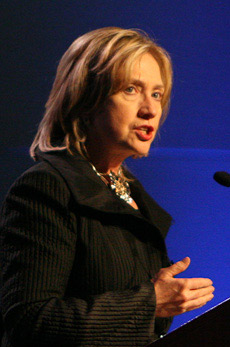 |
| images by Jill Gustafson |
“And USAID which was started with such high hopes by President Kennedy did so much good work in the 1960s and 70s – the green revolution , the absolutely extraordinary commitment that the United States, our researchers and our agricultural scientists made to improving agriculture around the world transformed the way people were able to feed themselves and to build a better future. Then over time, USAID became hollowed out. It became truly a shadow of its former self, it became not so much an agency of experts as a contracting mechanism. So the work that used to be done by development experts housed in the US government became much more a part of contracting out with NGOs here at home and around the world, so the identity, the reputation of USAID no longer was what it need to be”
—
“One aspect of what we’re doing to promote diplomacy and development that is quite new, and has special relevance for the Bay Area and Northern California, is our emphasis on innovation and the use of technology. We have been working very hard for the last twenty months to bring into the work we do the advances that many of the companies and the innovators entrepreneurs here in California have brought to business, have brought to communications in particular. You know, innovation is one of America’s greatest values and products, and we are very committed to working with scientists and researchers and others to look for new ways to develop heartier crops or lifesaving drugs at affordable costs, working with engineers for new sources of clean energy or clean water to both stem climate change and also to improve the standard of living for people. Social entrepreneurs who married capitalism and philanthropy are using the power of the free market to drive social and economic progress. ”
“And here we see a great advantage that the United States has that we’re putting to work in our every day thinking and outreach around the world. Let me just give you a couple of examples because the new communication tools that all of you and I use as a matter of course are helping to connect and empower civil society leaders, democracy activists, and everyday citizens even in closed societies. Earlier this year, in Syria, young students witnessed shocking physical abuse by their teachers. Now as you know, in Syria, criticism of public officials is not particularly welcome, especially when the critics are children and young people. And a decade earlier the students would have just suffered those beatings in silence. But these students had two secret weapons – cell phones and the internet. They recorded videos and pasted them on Facebook, even though the site is officially banned in Syria. The public backlash against the teachers was so swift and vocal that the government had to remove them from their positions.”
—
 |
“That’s why the United States in the Obama administration is such a strong advocate for the freedom to connect. And earlier this year last January I gave a speech about our commitment to internet freedom, which if you think about it, is the freedom to assemble, the freedom to freely express yourself, the right of all people to connect to the internet and to each other, to access information to share their views, participate in global debates. Now I’m well aware that telecommunications is not any silver bullet, and these technologies can also as we are learning can also be used for repressive purposes, but all over the world we see their promise. And so we’re working to leverage the power and the potential, in what I call twenty-first century statecraft. Part of our approach is to embrace new tools like using cell phones for mobile banking or to monitor elections. But we’re also reaching to the people behind these tools, the innovators and the entrepreneurs themselves. For instance, we know that many business leaders want to devote some of their companies expertise to helping solve problems around the world, but they often don’t know how to do that. What’s the point of entry? Which ideas would have the most impact?”
“So to bridge that cap, we are embracing new public private partnerships that link on the ground experience of our diplomats and development experts with the energy and resources of the business community. One of my first acts as Secretary was to appoint a Special Representative for Global Partnerships, and we have brought delegations of technology leaders to Mexico and, Columbia, Iraq and Syria, as well as India and Russia, not just to meet with government officials, but activists, teachers, doctors and so many more. ”
Report by James George
Video: Secretary Clinton at the Commonwealth Club on Clean & Dirty Energy
October 16th, 2010October 15, 2010 San Francisco
Secretary of State Hillary Rodham Clinton appeared at ClimateOne at the Commonwealth Club. In this excerpt, she answers a question about the administrations support for a tar sands pipeline from Alberta. Gregory Dalton asks, “How can the U.S. be saying climate change is a priority when we’re mainlining some of the dirtiest fuel that exists”?
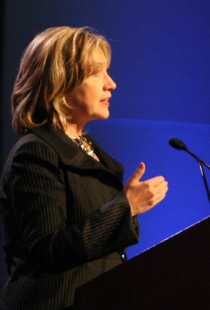 |
| images by Jill Gustafson |
Partial Excerpt: “We’re either going to be dependent on dirty oil from the Gulf or dependent on dirty oil from Canada, and until we can get our act together as a country, and figure out that clean renewable energy is in both our economic interest and the interest of our planet…”
“I mean I don’t think it will come as a surprise to anyone how deeply disappointed the President and I are about our inability to get the kind of legislation through the Senate that the United States was seeking. That hasn’t stopped what we’re doing. We have moved a lot on the regulatory front through the EPA here at home and we have been working with a number of countries on adaptation and mitigation measures, but obviously it was one of the highest priorities of the administration for us to enshrine in legislation President Obama’s commitment to reducing our emissions. So we do have a lot that still must be done.”
“It’s a hard balancing act. It’s a very hard balancing act. But it is also for me, energy security requires that I look at all of the factors that we have to consider while we try to expedite as much as we can America’s move toward clean renewable energy.”
Clinton concluded her appearance fielding a question from ten year old Eli, who asked what people can do to help the environment.
Speaking as a “private citizen” for a moment, she mentioned the “frustration, anxiety and even anger” in the United States today, “And I hope that people take some of that energy and focus it on the environment and on climate change, because we really need to have a longer range view of what’s going to make our country strong and rich and smart”.
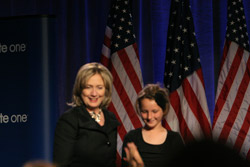
Clinton with ten year old Eli.
report by James George
Sea Change: Corals Reveal Climate Change’s Impact on Ocean – Technology & science – Science – OurAmazingPlanet – msnbc.com
October 13th, 2010‘Tropical corals in the western Pacific Ocean revealed that the depth where warm surface water and colder, deeper water meet, known as the thermocline, is getting shallower. The new study is the first physical evidence supporting what climate modelers have been predicting as the effects of global climate change on the ocean circulation below surface waters.’
China overtakes U.S. as biggest energy consumer: IEA | Reuters
October 12th, 2010‘Reuters – China has become the world’s largest energy user, having overtaken the United States, the head of the International Energy Agency said on Tuesday.’
via China overtakes U.S. as biggest energy consumer: IEA | Reuters.
U.S.-China Deadlock Dims Climate Talk Prospects – NYTimes.com
October 10th, 2010‘…Mr. Pershing’s Chinese counterpart, Su Wei, hit back, saying developed countries had failed to commit to substantial reductions in carbon emissions while making unfair demands of developing nations. He accused the United States of using the monitoring issue to try to avoid its own responsibilities on cutting emissions and providing financing and technology to poor countries.’
via U.S.-China Deadlock Dims Climate Talk Prospects – NYTimes.com.
Poor Prospects for New Climate Meeting – NYTimes.com
October 9th, 2010‘…There is no chance of completing a binding global treaty to reduce emissions of climate-altering gases, few if any heads of state are planning to attend, and there are no major new initiatives on the agenda. Copenhagen was crippled by an excess of expectation. Cancún is suffering from the opposite.’
Climate talks marred by bickering, progress on finance | Reuters
October 9th, 2010‘Frustration between the world’s two top carbon polluters overshadowed week-long U.N. talks seeking progress on the shape of a new climate pact, with negotiators making some progress on financing but failing to dispel fears the process could end in deadlock.’
via Climate talks marred by bickering, progress on finance | Reuters.
Video: Richard Muller on Climate Change and Energy
October 6th, 2010October 1, 2010 Berkeley, California
Professor Richard Muller, author of Physics for Future Presidents, spoke at a CITRIS sponsored event at the University of Calfornia Berkeley: Copenhagen Global Warming — The Current Status: The Science, the Scandal, the Prospects for a Treaty.
His discussion of the certainties and uncertainties of climate science was both entertaining and refreshingly candid.
Some key points:
- The IPCC report states that there is uncertainty about possible cloud cover increase due to increased carbon dioxide in the atmosphere. If cloud cover were to increase by two percent in the next fifty years we wouldn’t have global warming.
- Clean energy solutions in the U.S. that are too expensive to employ in China and other developing countries are rendered irrelevant by the projected scale of increased carbon emissions around the world.
- Muller mentioned several examples of attention grabbing overstatements and questionable scientific results. Data manipulation in one temperature chart which came to light in ‘climategate’ was clearly an example of bad science which wouldn’t pass peer review. Muller said he will be conducting his own completely transparent climate study.
see the full CITRIS video with slides
Report by James George
U.S. signs lease for first major offshore wind farm | Reuters
October 6th, 2010‘Reuters – U.S. Interior Secretary Ken Salazar on Wednesday formally signed the nation’s first lease for a major offshore wind project, as the Obama administration pushes forward to boost renewable energy output.’
via U.S. signs lease for first major offshore wind farm | Reuters.