
‘Barack Obama has been forced to defend his decision to allow the hunt for oil in the last great wilderness of the Arctic, on the eve of an historic visit to Alaska intended to spur the fight against climate change.’
News Roundup
Obama defends Arctic drilling decision on eve of Alaska climate change trip | Environment | The Guardian
August 29th, 2015Nasa: sea levels rising as a result of human-caused climate change – video | Science | The Guardian
August 28th, 2015‘Josh Willis of Nasa explains the space agency’s announcement that a long-term satellite imaging study has shown a dramatic rise in sea levels due to climate change. He says the findings that sea levels worldwide rose an average of nearly 3 inches (8 cm) since 1992 could indicate how strongly impacted coastal populations will be in the coming century’
Tutu, Klein and Chomsky call for mass climate action ahead of Paris conference | Environment | The Guardian
August 28th, 2015‘Desmond Tutu, Vivienne Westwood, Naomi Klein and Noam Chomsky are among a group of high-profile figures who will issue a mass call to action on Thursday ahead of the UN’s crunch climate change conference in Paris in December.’
Expert: We’re ‘locked-in’ to 3 feet sea level rise – CNN.com
August 28th, 2015‘According to Steven Nerem of the University of Colorado, we are “locked into at least 3 feet of sea level rise, and probably more.”‘
via Expert: We’re ‘locked-in’ to 3 feet sea level rise – CNN.com.
Christiana Figueres, sum of carbon management plans won’t hold 2C climate warming limit
August 25th, 2015July 16, 2015, San Francisco, Climate One at the Commonwealth Club
UNFCCC Executive Secretary Christiana Figueres and former EPA administrator William Reily joined Greg Dalton of Climate One for a discussion about the upcoming international COP21 climate negotiations titled “the Road to Paris”. Figueres’ comments about the upcoming climate deal were decidedly optimistic: countries are ‘playing ball’ and she cited a “good mood” developing internationally. Still, Figueres cautioned that the sum of the INDC – the voluntary national carbon emission reduction plans being submitted – would not be adequate to prevent overshooting the two degree Celsius upper limit agreed to in previous COP meetings.
The audience raised questions such as whether the two degree target is even low enough, and how should the Paris negotiators try to deal with the disparity between the increasingly urgent demands of climate science vs. the limited scale and speed of international emission reduction response. The official complete audio podcast with text transcription is available at Climate One.
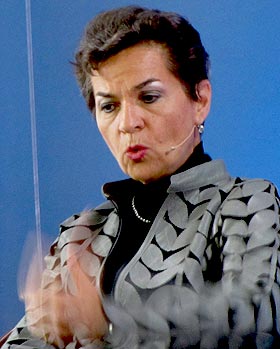
“We already know that the sum total of all of those carbon management plans … will not put us on the path of staying within the below two temperature goal that governments have agreed to and that science has suggested†~ UNFCCC Executive Secretary Christiana Figueres
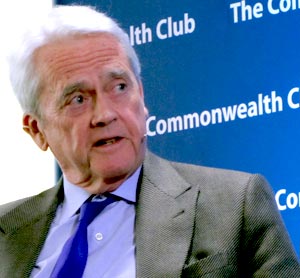
“We very much need a success in Paris. I would say that the bar has been set low enough that we will get one†~ William Reily
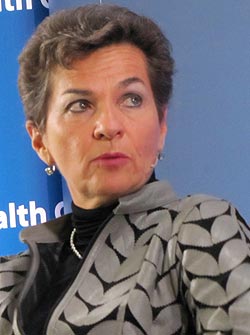
The conversation is not are we going to get to an agreement, but how are we going to get to an agreement… it’s about how do you maximize collaboration.†~ Christiana Figueres
Select Exerpts and Quotes
Figueres: “you know the fantastic thing about this – and it’s honestly nothing short of miraculous, there is not a single country, Russia included that is not playing ball. Yes they’re all playing the ball to their own interest, that’s what they have to do, but there is no country that has said they want to be exempted from this agreement. In fact all of them understand that it is in their interest to cover everyone. By definition, that’s going to be a complex agreement. They have presented their carbon management plan along with 39 other countries.”
“I cannot stand here and say that any one of them is the best ambition that has been set on the table in fact, we already know that the sum total of all of those carbon management plans – of which we expect to get at least two times as many by the time of Paris – the sum total will not put us on the path of staying within the below two temperature goal that governments have agreed to and that science has suggested.  So part of the complexity of the Paris agreement is, how do you construct something that receives and acknowledges all of those carbon management plans as being a baseline, a first step if you will, but also how do you construct the way forward that treats those only as a first step, as a down payment if you will, and then takes everyone together in an increasing collaborative manner toward the final ultimate destination which is the very difficult but absolutely necessary balance between the greenhouse gases that we will have and the natural absorption of the planet.  That is a very difficult to attain and even difficult to conceive right now that we would get to that point.  But it’s the only way out.â€
Figueres: “The conversation now is not are we going to get to an agreement but rather how are we going to do this. And the complexity is actually now the challenge.  It’s not about managing resistance, it’s about managing the complexity, how do you bring all of the components into a coherent whole which above all, bottom line, that agreement needs to potentialize collaboration across countries, inside countries across the different levels, across sectors.  It’s about how do you maximize collaboration, because I think the universal truth has now become very evident: We’re all better off with climate action – ASAP – than without.  So the question now for Paris is how do we do that?
Figueres: “Yes, there’s a huge threat, I’m not going to minimize the threat, but right next to that, there is a huge opportunity, for states, for cites.. and that narrative is starting to take real hold, it’s not just a narrative, there is actually a fundamental economic imperative that is being played out.”
Figueres: “There’s much more expectation of responsibility, corporate responsibility. So you see the likes of Ikea, Google, Apple, you know going 100% renewable, saying we want to produce our own renewable energy, why? Because their customers want them to be more responsible.”
Reily: “The surprise about the Pope’s statement – one expected that he would set out to the theological underpinnings for stewardship, creation care and the like, which previous popes have done eloquently. Â I think the surprise is that his message is on several planes. Â It’s on the plane certainly of theology and morality. Â It also gets very close to the realm of policy and action. Â It calls out people who are not accepting climate change and suggests that indifference or excessive belief in a technical solution or just opposition to science is unacceptable on a moral plane.”
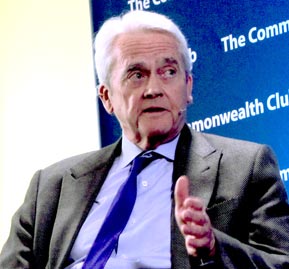
“I would say, you keep your eye on the ball. You get the deal in Paris, and then you build on it very rapidly and aggressively. We’re going to use the next four years and make as much progress as possible, all the while referring back to the Paris agreement that unified the world.” ~ Former EPA Administrator William Reily
Report by James George
Bushfires, heatwaves and early deaths: the climate is changing before our eyes | Tim Flannery | Environment | The Guardian
August 25th, 2015‘Our climate has already changed, and over the last decade we have begun to witness more frequently the consequences of our profligate burning of coal, oil and gas. Very recent advances have allowed scientists to quantify the human impact on individual extreme weather events. Extremes in the weather are therefore a good place to begin looking at what has changed in climate science over the past decade.’
Attorney Hounding Climate Scientists Is Covertly Funded By Coal Industry
August 25th, 2015‘Last Thursday’s bankruptcy filing of Alpha Natural Resources, one of the largest coal companies in America, includes line items for all of the corporation’s contractors and grant recipients. Among them are Horner individually at his home address, as well as the Free Market Environmental Law Clinic, where he is a senior staff attorney.’
via Attorney Hounding Climate Scientists Is Covertly Funded By Coal Industry.
World must face up to cost of carbon reductions, says European climate expert | Environment | The Guardian
August 25th, 2015‘The former European commissioner for climate action Connie Hedegaard has urged countries to acknowledge the cost of reducing emissions to fight climate change, and called on politicians to shift away from short-term thinking.’
Energy secretary optimistic for climate pact | TheHill
August 25th, 2015‘Moniz said advances in technology are the main reason that he is optimistic about the results of the December meeting in Paris hosted by the United Nations, where world leaders hope to come to a deal on reducing greenhouse gases.’
Controversial Climate-Change Solution May Be In The Clouds | TechCrunch
August 25th, 2015‘In a move that has some environmentalists up in arms, a group of retired Silicon Valley engineers and scientists are proposing a new approach to fighting climate change. They want to brighten clouds.’
Sounds fishy?
‘…it is now time to test how successfully their machine can shoot tiny seawater droplets into the atmosphere’
via Controversial Climate-Change Solution May Be In The Clouds | TechCrunch.