
‘Pressing ahead with plans to reduce greenhouse gas emissions despite a congressional stalemate over global warming, the Environmental Protection Agency on Wednesday issued guidelines that gave states considerable discretion in regulating carbon dioxide emissions from large industrial facilities.’
News: ‘Climate & Energy’ Archive
Environment, greenhouse gas, regulations: EPA issues state guidelines for greenhouse gas emissions – latimes.com
Thursday, November 11th, 2010Cities as Hubs of Energy and Climate Action – NYTimes.com
Wednesday, November 10th, 2010‘Jay Carson, a former deputy Los Angeles mayor and aide to both Clintons, and Rohit Aggarwala, the former chief sustainability advisor to New York City Mayor Michael R. Bloomberg, are going to work for C40 Cities, a coalition of cities in rich and developing countries working to initiate and share ways to cut emissions of greenhouse gases and boost resilience to impacts of climate change.’
via Cities as Hubs of Energy and Climate Action – NYTimes.com.
Uranium Energy Corp Commences Major Drilling Program at Salvo Project in South Texas
Wednesday, November 10th, 2010‘CORPUS CHRISTI, TX, Nov. 10 /PRNewswire/ – Uranium Energy Corp (NYSE AMEX: UEC; the “Company”) is pleased to announce the start of drilling at the Company’s 100%-controlled Salvo Project in Bee County, Texas. The objective of the current drilling program is to verify the historic resource and to expand on the resource by drilling new areas of mineralization. The exploration drill plan will consist of two phases, each utilizing two rigs.’
via Uranium Energy Corp Commences Major Drilling Program at Salvo Project in South Texas.
EPA subpoenas Halliburton over fracking fluids | Reuters
Wednesday, November 10th, 2010‘(Reuters) – The Environmental Protection Agency said on Tuesday it has issued a subpoena to Halliburton, demanding information about chemicals it uses in a natural gas drilling technique called “fracking.”‘
via EPA subpoenas Halliburton over fracking fluids | Reuters.
U.S. to announce home energy efficiency initiatives | Reuters
Tuesday, November 9th, 2010‘(Reuters) – Vice President Joe Biden is to announce a series of initiatives on Tuesday aimed at helping middle-income Americans make their homes more energy efficient and boost job growth among home retrofitters.’
via U.S. to announce home energy efficiency initiatives | Reuters.
What the election means for renewable energy – Nov. 5, 2010
Tuesday, November 9th, 2010‘FORTUNE — Companies in renewable energy industries are trying to figure out how to navigate the swing rightward from the midterm elections. Starting with the worst casae scenario, projects that received some of the $16.8 billion in stimulus funding allocated to the Office of Energy Efficiency and Renewable Energy in 2009 could now be left to wither, without getting the chance to return the promised green megawatts per dollar invested.’
via What the election means for renewable energy – Nov. 5, 2010.
E.U. sees U.S. disappearing as partner on climate | Reuters
Sunday, November 7th, 2010‘(Reuters) – The European Union sees the United States “disappearing as a partner” in international climate talks after President Barack Obama suffered setbacks in midterm elections, the EU’s top climate official said on Friday.’
via E.U. sees U.S. disappearing as partner on climate | Reuters.
Video of “Proposition 23: Yes or No?” Debate Opening Statements
Tuesday, November 2nd, 2010November 1, 2010 San Francisco, California
Climate One at the Commonwealth Club held a eleventh hour debate on Proposition 23, on the eve just before the election. While the positions discussed were charged and contentious, the speakers on both sides of the issue maintained a respectful demeanor throughout.
This video segment shows the opening statements of each speaker, beginning with Tom Tanton and then Jack Stewart on the pro Prop 23 side, and followed by Nancy Floyd and Bob Epstein arguing the nay case.
Since Proposition 23 is largely funded by Texas oil companies, the nay side has taken to framing Prop 23 as a sort of state’s self-determination issue. So Bob Epstein humorously ended his opening statement with a reference to another ongoing California/Texas clash, the world series. While the debate was going on, those in attendance of course were missing watching the game between their home team, the San Francisco Giants and the Texas Rangers, being played out in Texas. After the debate, several people from the audience, including two of the debaters, slipped into a bar across the street just in time to catch the final inning of the World Series. In this case the California side prevailed, while the fate of proposition 23 remained to be determined the following day.
This brief video shows the ecstatic reaction of San Francisco Giants fans inside the bar as they watch the final moments of the game.
Video: Erin Rogers on Prop 23 and Lesser Known Prop 26’s Potential Impacts on AB 32
Monday, November 1st, 2010October 28, 2010 University of California, Berkeley
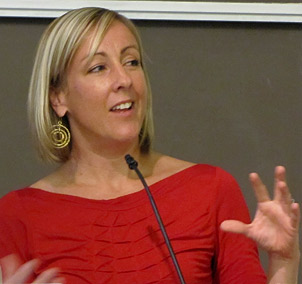 Erin Rogers, Western Region Manager of the Climate & Energy Program, Union of Concerned Scientists spoke at the Goldman School of Public Policy at the University of California, Berkeley on the potential impacts of Propositions 23 and 26 on the implementation of the California Global Warming Solutions Act of 2006 (AB 32).
Citing polls showing support for Prop 23 falling, she drew attention to lesser known Prop 26, which could also impact California’s ability to implement AB 32 by recasting carbon emission ‘fees’ as ‘taxes’, each of which would then require an elusive two thirds majority vote before implementation.
In response to questions from the audience, she discussed many topics including the use of feed in tariffs to support the development of solar energy and green jobs, expected free emission permits for polluting industries such as cement and glass during the initial years of AB 32, studies on the AB 32 net effect on California job numbers, and possible broader economic impacts of climate change in California.
The event was co-sponsored by the Goldman School of Public Policy and BERC, the Berkeley Energy and Resources Collaborative
Report by James George
Adobe on Clear Lake?
Monday, November 1st, 2010Adobe on Clear Lake? by Elizabeth Montgomery
One wouldn’t expect to find adobe structures going up along the shores of Clear Lake just now. The area has been hard hit economically and even most conventional construction has come to a halt. However, an innovative building project using natural, local materials is in full swing as part of developing tiny Clarks Island in Clearlake Oaks. The current construction, dubbed “entrance art,” consists of a sign, a kiosk, and a roofed sitting area, all on shore. Plans are in the works for a 30-foot diameter pagoda—an open, gazebo-like building—on the one-acre island itself.
Local teenagers and grade-schoolers were among the volunteer construction workers at this past Saturday’s “adobe-making party.” They and their elders could be seen mashing straw into mud with their bare feet and forming large bricks out of the resulting mixture. Along with the useful work and educational opportunities of the event, creative and playful uses for the wet clay soil were inevitably discovered. Young mud-pie chefs pretended to peddle their confections and teen girls painted each others’ faces.
The foreman of this lively crew wasn’t hard to pick out, but wasn’t what one might expect either: a petite, mud-spattered woman named Massey Burke. She directed the proceedings with an infectious enthusiasm, while answering any questions on natural building with the polish of the instructor she is. A San Francisco Bay Area resident, she teaches classes through the Solar Living Institute in Hopland.
“I don’t think people realize how cutting edge [the Clarks Island project] is,” said Burke. She was speaking not just of the unconventional building materials and methods, but of the grassroots inception of the project and the community’s continuing involvement in it. Also, it is hoped that precedents for obtaining government building permits will be set not just locally, but nationally.
According to Holly Harris, a community leader, it was Lake County Supervisor Denise Rushing who initially planted the seed for the Clarks Island Sustainability Initiative. This is a larger effort toward wise resource use and environmental preservation that includes the building project. Her vision was embraced and expanded by the community and now is supported by a remarkable array of government agencies, local businesses, groups, and individuals. A quarter of the capital used for construction by the county’s Redevelopment Agency, which owns the land, was raised by the people and businesses of the Clear Lake Oaks area. They are also donating most of the labor and materials.
Burke says that in addition to being durable and beautiful, earth-based materials such as adobe have a number of particular advantages. First, they don’t deplete scare resources, such as wood, and are readily available locally. (Copper Cross Vineyard, just down the highway from Clarks Island, donated clay for its structures.) Further, adobe and straw-bale walls work well in buildings with “passive solar design,” architecture which allows direct heating by the sun. Adobe has a high thermal mass, only changing temperature slowly. It is often employed in conjunction with straw bale walls, which are especially insulating. Moreover, such materials have only 1% of the “embodied energy” of brick or cement, meaning that they deplete energy resources far less in their making, as well as being less expensive.
When asked about health issues and indoor air quality Burke said, “This is where I’m going to sound like a prophet for clay.” Clay minerals balance humidity and actually absorb toxins from the air. Burke said clay is “better for indoor air quality than almost any other material.”
A disadvantage of adobe can be high labor costs. However, if a community comes together to build, as at Clarks Island, it can be inexpensive. Burke said that community housing might eventually be constructed using the principles pioneered in the current project.
The kids who came to Clarks Island last weekend were participating in updated but ancient building techniques. Burke says that people usually have to go abroad to develop expertise in these lost arts. “You can’t go get a degree in natural building from any higher institution that I know of in this country,” she said. Things are changing, however, and the University of San Francisco’s Department of Architecture is hoping to bring students to Clarks Island soon for some exposure to methods not covered in its standard curriculum.
Burke advises do-it-yourselfers who want to experiment with small adobe projects to start with a garden wall or pizza oven. Larger projects include insulating or even replacing walls.
For more information visit KonoctiTrails.com/clarks-island or verticalclay.com.
First printed in Lake County Record Bee (Oct. 20, 2010)